
This was not a relaxing “retreat.”
It felt more like a Buddhist monk boot camp: lots of discomfort, self‑inflicted pain, strict rules, wanting to quit, feeling like a failure, and then a strange sense of reward at the end.
People reading this are probably:
-
Friends who want to know what happened to me
-
People thinking of joining a retreat like this
-
People who finished one and want to compare experiences
To make it easier, the story is in three parts:
-
Part 1 (this section)
-
What I signed up for
-
The quiet mind
-
Awareness: Spiderman and Google Earth
-
Forced fasting: two meals a day
-
-
Part 2
“Stardusts, gong baths, and the madness of Vipassana (insight) Meditation” -
Part 3
Quitter, wimp, pain
Other random things from the edge of insanity
Aftermath: The ten days after the ten days
1. What I signed up for
I joined a 10‑day silent meditation retreat.
It followed the method taught by S. N. Goenka, offered around the world. The course itself is free. At the end, you can donate whatever you want. (Details: https://www.dhamma.org/en-US/index)
The idea was:
-
Live like a monk for 10 days
-
Practice Vipassana meditation
-
Learn some basic Buddhist ideas
A typical day looked like this:
-
4:00–4:30: Wake up
-
4:30–6:30: Meditate
-
6:30–8:00: Breakfast and break
-
8:00–11:00: Meditate
-
11:00–1:00: Lunch, short chance to speak with the teacher, and break
-
1:00–5:00: Meditate
-
5:00–6:00: Snack and break
-
6:00–7:00: Meditate
-
7:00–8:15: Listen to recorded talks (discourses)
-
8:15–9:00: Meditate
-
9:00–9:30: Sleep
That is more than 10 hours of meditation every day. The schedule never changed.
Halfway through, the difficulty increased. Three meditation hours became “strong determination” sittings, called adhiṭṭhāna. In these sessions, you were not allowed to move at all.
On top of that, there were strict rules:
-
No communication with others: no talking, no gestures, no eye contact
(You could speak briefly with helpers and the teacher.) -
No books, no writing, no phones or computers, no mirrors.
-
No exercise.
-
Only two vegetarian meals a day. At 5 pm, you got some fruit as “dinner,” then nothing until breakfast at 6:30 am.
Sleeping was rough.
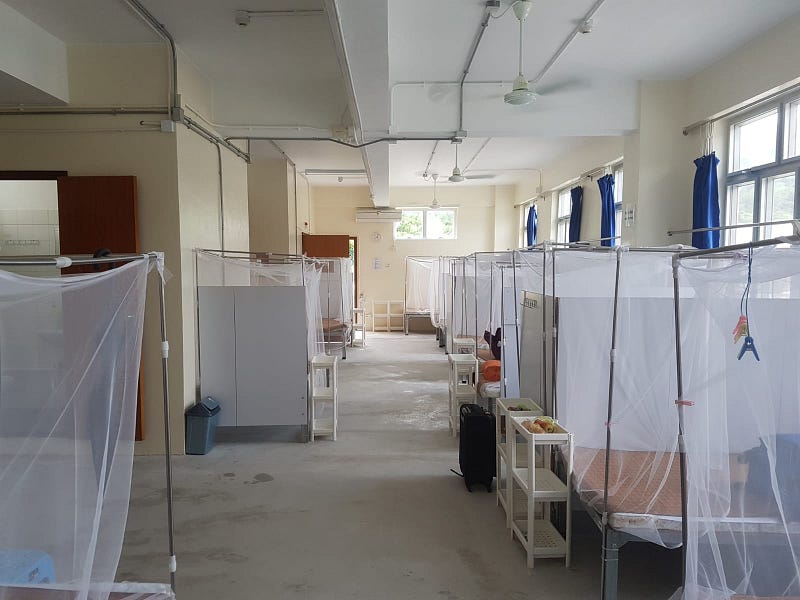
In my case, about 20 men slept in one room. There was:
-
The smell of old sweat
-
Half‑washed underwear hanging on makeshift clotheslines
-
Shared bathrooms attached to the room
-
All the sounds people make while sleeping
2. The abyss of clear‑mindedness
The rules and setup stripped away almost all distractions.
No conversations, no social media, no choosing where to eat, no workouts. With all of that removed, the noise in my head faded slowly, and then completely.
By around day 7, my mind became unusually quiet.
It felt like:
-
Sitting in a very quiet room
-
Or looking at a still pond, with only tiny ripples from my breath and heartbeat
The silence felt extreme.
It was as if every tiny sound could be heard, even a speck of sand falling. The calm was almost addictive. Self‑talk in my head became very clear, and it was easy to remember my thoughts.
That clarity was both amazing and disturbing:
-
I “wrote” whole articles in my head and could recall them the next day
-
Old memories, like my first girlfriend dumping me, came back in sharp detail
The level of change will be different for each person.
It depends on how well you know your own mind. My mind is usually very busy, so the contrast was dramatic. Unless you have tried something this extreme, you might not realize how much can be revealed.
3. Spiderman and Google Earth (Awareness)
The meditation also sharpened my awareness.
When you push your body and mind in an extreme way, something is bound to change. If you lifted weights with your biceps 10 hours a day for 10 days, your biceps would change. This was like doing that with the brain. It changed bigly.
Vipassana focuses on noticing bodily sensations:
-
The feeling of air passing through the nostrils
-
Tiny tingles in places like your toes
Over time, I became much more aware of my sensations.
I got so bored watching my breath at one nostril for hours that my mind started noticing more details. Suddenly I could feel differences in temperature and humidity between the air going in and the air coming out.
I began to notice sensations linked to emotions.When painful memories came up, like being dumped, I could feel my body reacting:
-
Shame would show up as a tightness on the upper left side of my chest
At first, I thought it was my imagination or just heartburn from eating too many potatoes at lunch. But every time I thought about:
-
My ex‑girlfriends dumping me
-
Or the shame of packing my things into a cardboard box after being fired from my first job
…the same tight feeling returned, often clearer, and hence, much stronger.
My awareness also became wider.
It felt like having Spiderman’s spider‑sense:
-
I could notice tiny sensations all over my mind and body
-
At the same time, I could zoom in deeply on one emotion
It was like using Google Earth on my inner world:
-
From far away, I could sense many emotions and sensations at once
-
Then I could “zoom in” and feel, for example, the exact point where disgust and fear met
As with clear‑mindedness, this level of change will differ for everyone.
But if you “work” your brain for 10 hours a day for 10 days, it will not be the same. The change was huge and very foreign.
4. Forced fasting – two meals a day
My relationship with food changed a lot.
It was almost like having a new girlfriend.
First, I noticed how little I needed to poop.
We simply did not eat much food. Still, most people did not really struggle with this involuntary kind of fasting.
I realized that in normal life, we probably eat far more than our bodies need.
At the retreat:
-
Hunger was bearable and faded quickly
-
There were no choices, so we just sat with the feeling
In daily life, it is harder:
-
Food is everywhere
-
The sight and smell of food makes hunger feel unbearable
With a quiet mind and sharper awareness, my sense of taste became intense.
Simple toast with butter tasted amazing:
-
The fat and grease seemed to cover every part of my tongue
-
The sweetness from the bread’s starch felt like a small explosion of pleasure
Because of this awareness and clarity, even slightly stale toast tasted almost heavenly.
This new way of experiencing food was something I really enjoyed.
Continue to Part 2: “Stardusts, gong baths, and the madness of Vipassana (insight) Meditation.”
Leave a Reply